News
Why Modern Grids Require Grid-Forming Storage for Stability and Resilience
- January 20, 2026
Power networks worldwide face a basic shift right now. Big synchronous generators slowly make room for renewable sources like solar PV, wind power, and distributed energy resources (DERs). This move quickens the push toward lower carbon use. At the same time, it creates fresh technical issues. Less system inertia, power moving in two ways, and spread-out generation leave current grids weaker than in the past.
Grid-forming storage for modern grids comes forward as a key tool in this setting. It differs from standard grid-following gear. Grid-forming battery energy storage systems (BESS) set up voltage and frequency points on their own. This setup supports steady operation, durability, and speedy bounce-back in big utility areas and behind-the-meter (BTM) places.
How Modern Power Grids Are Changing
Back in time, power grids counted on large spinning devices for inertia and fault current. Inverter-based resources step in now and take their place. As a result, grids face quicker frequency shifts and less solid voltage handling. You see this most in spots with lots of renewables, standalone grids, and factory lines with big peak demands.
Behind the meter, commercial and industrial (C&I) customers change how the grid acts, too. PV for own use, EV charging spots, and data centers now join as lively grid parts. They no longer just take power quietly. Such updates require storage units that go further than matching grid hints. These units need to hold the grid steady by themselves.
What Makes an Energy Storage System “Grid-Forming”?
A grid-forming energy storage system skips looking for voltage and frequency points from the grid. It makes them from within. To do this, it uses smart control approaches like VF control and virtual synchronous generator (VSG) modes.
Key Differences Between Grid-Following and Grid-Forming Storage
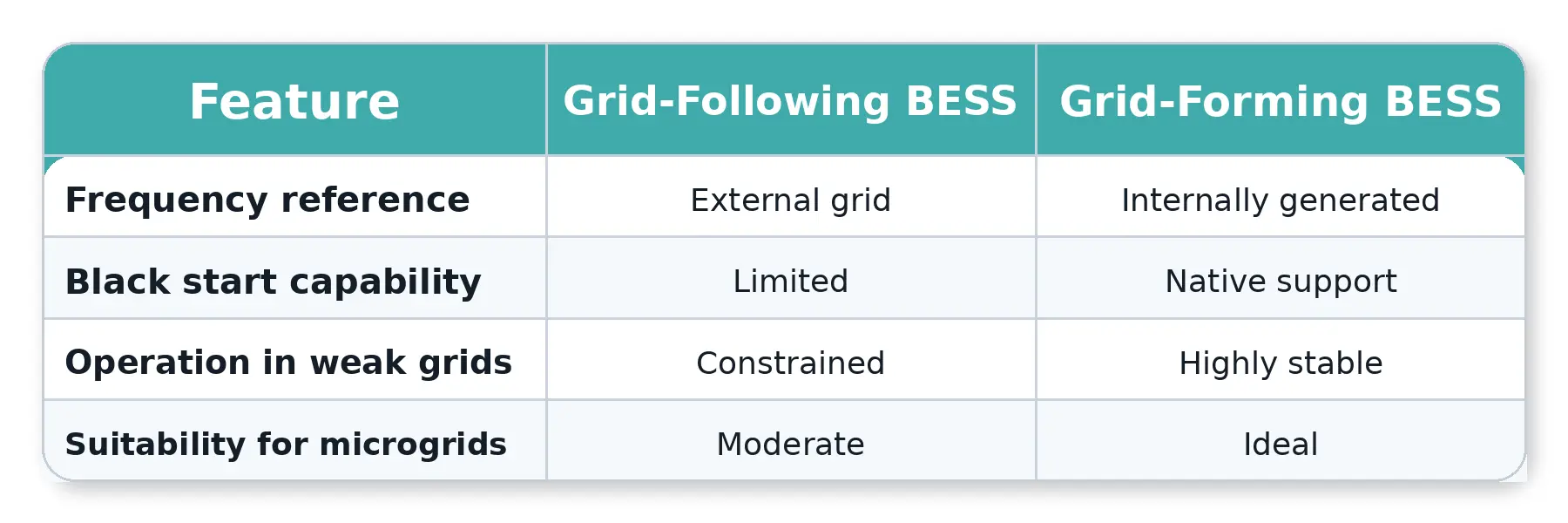
This split shows what sets a grid-forming energy storage system apart. It also points out why such systems matter for today’s grids. That holds true as inertia keeps falling.
Why Grid-Forming Storage Is Essential for Stability and Resilience
Grid-forming storage hits three main problems in current grids right away.
For frequency stability, grid-forming BESS acts in milliseconds against frequency changes. It steadies networks with little inertia. And it does so without pulling from spinning backups.
For voltage support, grid-forming systems handle voltage size and phase angle. Because of this, they firm up weak grids, also lift fault ride-through results.
For resilience and recovery, grid-forming storage makes islanded running possible in outages. It backs black start and smooth links back. All this keeps key loads running without breaks.

Behind-the-Meter Storage and Peak Shaving Explained
focuses on reducing demand charges, optimizing TOU tariffs, and improving on-site power stability.
BTM Storage Sizing for Peak
Shaving
BTM storage sizing calls for matchin Lots of C&I users ask about behind-the-meter energy storage. They want to know what it means. And they ask how it gets sized for peak shaving.
Behind-the-meter storage goes on the customer’s side of the utility meter. In practice, BTM storage sizing peak shaving power (kW) with energy (kWh).
- Power sets how much peak demand gets cut.
- Energy sets how long peak shaving or backup goes on.
Grid-forming ability brings extra worth. It keeps the voltage and frequency solid during heavy load times. This proves useful above all when the grid runs weak or is jammed.
Advanced BMS: The Hidden Foundation of Grid-Forming Storage
One usual query covers advanced BMS. What part does it play in stretching battery life? And how does it keep safety in C&I systems?
In grid-forming BESS, the Battery Management System (BMS) handles much more than watching cells. Smart builds, like protection at the cluster level and active balancing, let each battery group work alone. This boosts uptime. It stops faults from moving on. Plus, it lengthens battery life during common charge-discharge rounds.
FFD POWER’s own BMS turns old three-level setups into a two-level one. This setup speeds up reactions. It also makes grid-forming work safer in piece-by-piece systems.
One System, Multiple Revenue Streams
C&I users often ask if a single storage system can pull off TOU arbitrage well. Can it also offer grid frequency services?
Yes, that works if the EMS and PCS get built right. Current grid-forming BESS changes modes on the fly.
- TOU arbitrage and peak shaving fit daily runs.
- Frequency containment reserve (FCR) or fast frequency response suits grid happenings.
- Islanded operation covers outages.
This range of uses lifts how well assets get employed. It raises project returns, too.
Product-Level References
For instance, FFD POWER offers a wide set of grid-forming-capable BESS for utility and C&I uses.
- Galaxy 5015 centralized and string-type containerized systems give 2.5MW / 5MWh setups with VF, VSG, and PQ modes. The 20-foot container style (approx. 6058 × 2438 × 2896 mm) pulls together PCS, BMS, EMS, fire suppression, and SCADA for simple plug-and-play rollout.
- Galaxy 233L / 261L liquid-cooled cabinets bring small BTM answers with 233–261 kWh capacity and 100 kW-class PCS. These fit peak shaving and microgrids nicely.
- In Israel, 64 units of 233 kWh cabinets run in matched string builds. This proves growing grid-forming action in true setups.
These systems back black start, smooth on/off-grid shifts, and quick replies under 200 ms. They meet the main needs for current grids.
Representative Suppliers Commonly Referenced in Grid-Forming Projects
There are some Known suppliers:
FFD POWER
- Grid-forming–native architecture
Built-in VF and VSG control sets steady voltage and frequency points in weak grids, microgrids, and cut-off C&I systems. - Cluster-level advanced BMS
Separate cluster guards and active balancing raise system uptime, safety, and battery life under heavy-cycle peak shaving and grid service tasks. - BTM peak shaving optimized
Shaped for behind-the-meter storage sizing, it holds up peak shaving, TOU arbitrage, and grid backing in one energy storage piece. - Modular and scalable design
Cabinet and containerized systems let easy add-ons from C&I spots to multi-megawatt grid-forming jobs. - Proven multi-unit deployment
Matched multi-cabinet and container rollouts show steady grid-forming action in real jobs.
BYD
BYD earns notice for full-chain battery making. It covers cells, modules, and whole storage systems. Its fixes show up a lot in big-scale and setup-focused energy storage work. There, making size and lasting steadiness rank high.
Tesla
Tesla puts out even, high-capacity energy storage systems. These land mostly in utility-scale work. The fixes stress central builds, quick setup, and software-led control. They suit places with grown grid bases best.
Siemens
Siemens offers solid know-how in grid tying, auto-running, and energy handling systems. Its best parts cover system-wide control, grid rule following, and links to transmission and distribution bases. This stems more from the control gear than the battery parts.
Sungrow
Sungrow holds a strong place in PV plus storage tying. It builds on its past inverter. The energy storage fixes often go into solar-focused projects. There, inverter work and PV join efficiency lead design picks.
Conclusion
Current power networks can’t lean just on quiet, grid-following items anymore. In many growing power networks, grid-forming skills turn from extra picks to must-have grid rules. As renewables grow in share and loads shift more, grid-forming storage for modern grids grows from a side choice to a base tool.
For C&I users, well-planned BTM storage sizing for peak shaving works with grid-forming skills. This brings not just money savings but also durability, power evenness, and lasting bend. With smart BMS, sharp EMS, and piece-based builds, grid-forming BESS changes what energy storage reaches.
FAQ
Q: Should I go with an online UPS or a 10 ms seamless transfer switch?
A: Online UPS brings no-switch-time guard for key loads. Seamless transfer switches fit less touchy uses. Grid-forming BESS can mix both jobs.
Q: What makes an energy storage system grid-forming?
A: It makes voltage and frequency points on its own. This allows steady running without grid backing.
Q: Can one storage system handle TOU arbitrage and grid services?
A: Yes. With smart EMS steps, the current BESS shifts between arbitrage, peak shaving, and frequency reply.
Q: What does behind-the-meter energy storage mean?
A: It points to storage set on the customer’s meter side. The main push covers peak shaving, cost tuning, and durability.
Q: Why is advanced BMS critical in C&I energy storage?
A: It makes sure of safety, fault cut-off, longer battery life, and solid running under high rounds and grid-forming setups.