News
Microgrids: Resilient Power Solutions for Factories, Campuses, and Communities
- October 17, 2025
As energy demand grows and grid instability becomes a global concern, microgrids are emerging as the cornerstone of energy resilience.
For factories, campuses, and communities, microgrids deliver reliable, efficient, and sustainable power — even when the main grid fails.
What Is a Microgrid?
A microgrid is a localized energy network that can operate either connected to the public grid (on-grid) or independently (off-grid).
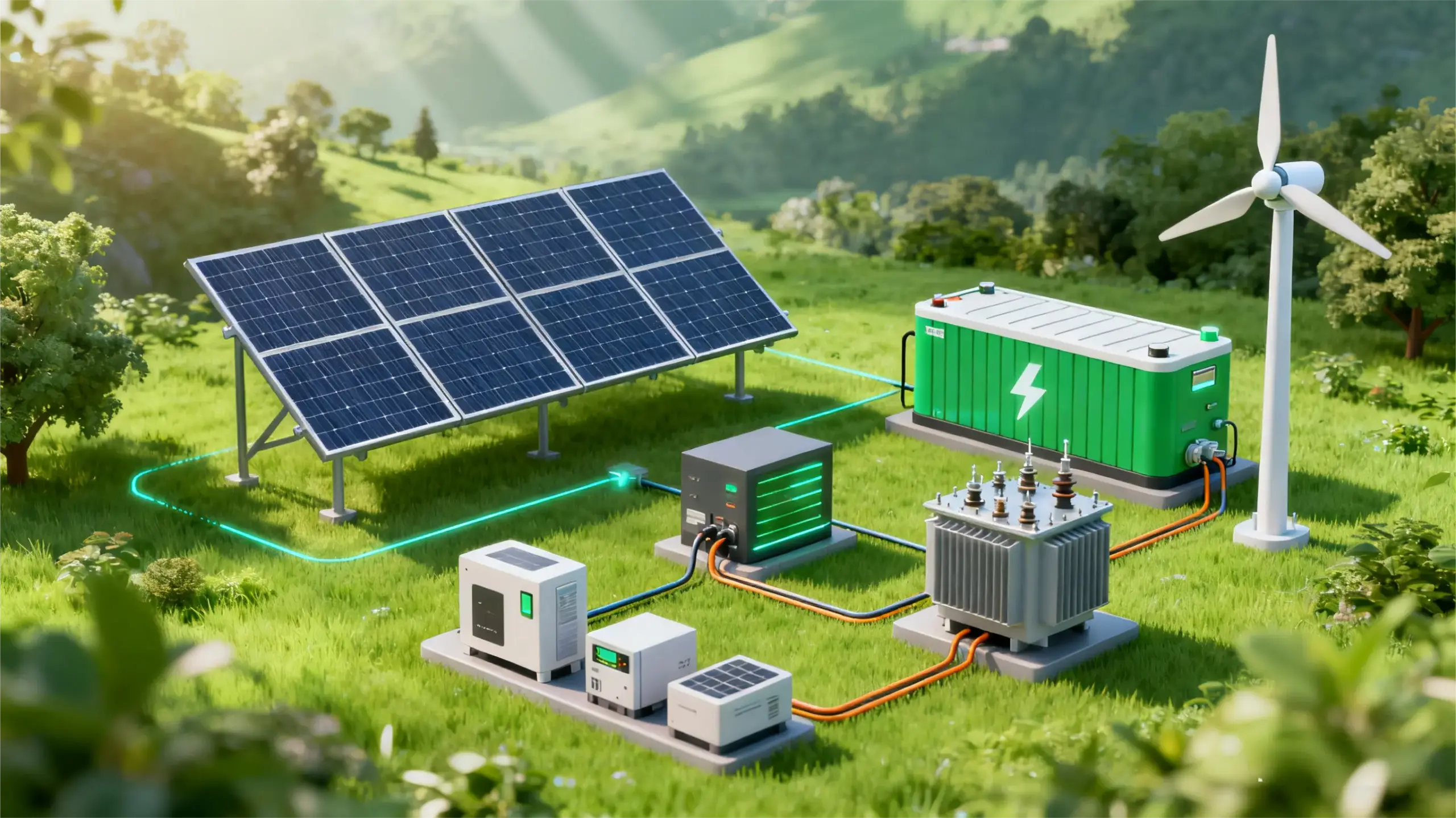
It integrates multiple energy sources — such as solar PV, wind, diesel generators, and battery energy storage systems (ESS) — under the coordination of an Energy Management System (EMS).
When connected to the main grid, a microgrid can optimize energy usage and reduce costs. When disconnected, it can island itself and continue providing power autonomously.
Key Components of a Microgrid:
Distributed generation (e.g., solar panels, wind turbines)
Energy storage system (ESS) for stability and peak management
Load management system for prioritizing critical loads
Energy Management System (EMS) as the intelligent control core
Why Microgrids Matter for Industrial and Commercial Users
For industrial zones, manufacturing plants, or large campuses, microgrids represent not just an energy solution — but a strategic investment in operational continuity and cost efficiency.
Key Benefits:
🔋 Energy Resilience: Maintain uninterrupted operation during grid outages or voltage fluctuations.
☀️ Renewable Integration: Combine solar and wind power with batteries to maximize green energy use.
💰 Cost Optimization: Perform energy arbitrage, shifting loads to off-peak periods to reduce electricity bills.
🧠 Smart Control: Advanced EMS ensures real-time optimization of generation, storage, and consumption.
🌍 Sustainability: Reduce carbon footprint and align with global ESG targets.
For factories and business parks, this means stability, savings, and sustainability — all in one system.
Types of Microgrids
Depending on the operating mode and energy source configuration, microgrids can be classified into:
On-Grid Microgrids: Connected to the main utility grid, exchanging power and optimizing energy costs.
Off-Grid Microgrids: Fully independent systems, ideal for remote areas or regions with unstable grids.
Hybrid Microgrids: Combine both, enabling smooth transitions between grid-connected and islanded operation.
Hybrid microgrids are becoming the mainstream model, providing the flexibility to choose the optimal mode based on energy prices, renewable availability, and grid conditions.
Applications Across Different Sectors
🏭 Industrial Parks & Factories
Ensure continuous production during grid outages while reducing peak demand charges.
🏫 University Campuses
Power buildings efficiently and integrate solar rooftops and EV charging into a smart, unified grid.
🏘️ Communities & Smart Cities
Support local renewable energy generation and improve grid stability at the neighborhood level.
🏥 Hospitals & Data Centers
Guarantee uninterrupted power supply to critical infrastructure with multi-layer redundancy.
FFD POWER’s Role in Building the Future of Microgrids
At FFD POWER, we design and deploy intelligent microgrid systems that seamlessly integrate renewables, storage, and smart control.
Our advanced EMS platform — powered by AI algorithms and cloud-based optimization — enables predictive management, energy cost forecasting, and automatic fault response.
From industrial factories in Europe to off-grid communities in Africa, FFDPOWER is empowering customers to achieve true energy independence with high-efficiency, safe, and sustainable microgrid solutions.
The Future: Microgrids as the Backbone of Energy Resilience
As global energy systems evolve toward decentralization, microgrids will become the backbone of resilient, intelligent, and low-carbon energy infrastructure.
By combining storage, AI, and renewables, they turn traditional power systems into adaptive, self-sufficient ecosystems — ready for the challenges of the modern energy era.