News
C-Rate Explained: The “Acceleration” Factor of Energy Storage Systems
- October 16, 2025
Introduction: What Is the C-Rate?
In the world of energy storage systems (ESS), few technical terms are as important — and often misunderstood — as the C-rate.
The C-rate defines how quickly a battery can be charged or discharged relative to its capacity.
Think of it as the “acceleration” of your battery system. Just as a car’s acceleration determines how quickly it reaches full speed, the C-rate determines how fast your battery can deliver or absorb energy.
Understanding the C-rate is essential for optimizing system performance, ensuring safety, and extending the overall battery life. It directly affects how efficiently an energy storage system operates and how profitable it can be over time.
1. Definition: What Does 1C, 0.5C, or 2C Mean?
The C-rate represents how fast a battery can be charged or discharged relative to its rated capacity. It tells us the speed at which energy moves in or out of the battery.
When a battery operates at 1C, it means the battery will be fully charged or discharged in one hour. A 0.5C rate means it takes two hours to complete a full charge or discharge, while a 2C rate means the process happens twice as fast — in just half an hour.
For example, imagine a 100 ampere-hour (Ah) battery:
At 1C, it charges or discharges at 100 amps and will be full or empty in one hour.
At 0.5C, the current is 50 amps, taking two hours.
At 2C, the current doubles to 200 amps, completing in 30 minutes.
In simple terms, a higher C-rate means faster charging or discharging, which delivers more power in less time — but it also generates more heat and stress on the battery. A lower C-rate means slower operation, which enhances efficiency, stability, and cycle life.
Understanding these rates helps system designers choose the right balance between speed, safety, and longevity, ensuring the energy storage system performs reliably under real-world conditions.
2. Why the C-Rate Matters for Energy Storage Systems
The C-rate directly affects three key aspects of every energy storage project — power performance, battery life, and safety.
(1) Power Output and Response Speed
A higher C-rate allows the battery to deliver more power in less time. This is crucial for applications that require fast response, such as:
Grid frequency regulation
Peak shaving and load shifting
Emergency backup power
(2) Battery Life and Degradation
Fast charging and discharging at high C-rates increases internal stress and heat, which accelerates battery degradation. Conversely, operating at lower C-rates improves cycle life and system reliability.
FFDPOWER carefully optimizes charge and discharge profiles to ensure each system achieves the best balance between performance and longevity.
(3) Efficiency and Safety
High C-rates can lead to internal resistance losses and heat generation, reducing overall Round-Trip Efficiency (RTE). Proper thermal management and Battery Management Systems (BMS) are essential to keep the system within safe temperature limits.
3. Typical C-Rates for Different Applications
Different energy storage applications require different charge and discharge speeds. The ideal C-rate depends on how quickly the system needs to respond, how long it operates per cycle, and how important long-term battery life is to the project.
For residential energy storage systems, the typical C-rate is between 0.3C and 0.5C. These systems usually prioritize high efficiency, quiet operation, and long cycle life rather than rapid power delivery. A lower C-rate ensures smooth charging from rooftop solar systems and steady discharge during evening consumption.
In commercial and industrial (C&I) energy storage, the C-rate typically ranges from 0.5C to 1C. These systems must strike a balance between power output and durability, handling tasks such as peak shaving, energy arbitrage, and backup power. The goal is to maintain strong discharge capability while protecting the battery from excessive wear.
For grid-level services such as frequency regulation, voltage support, or spinning reserve, much higher C-rates — often 1C to 2C or more — are required. In these scenarios, energy storage systems must respond in seconds to grid fluctuations, providing fast and precise power adjustments. Although these high C-rates allow rapid response, they also shorten the battery’s lifespan and require advanced cooling and control systems.
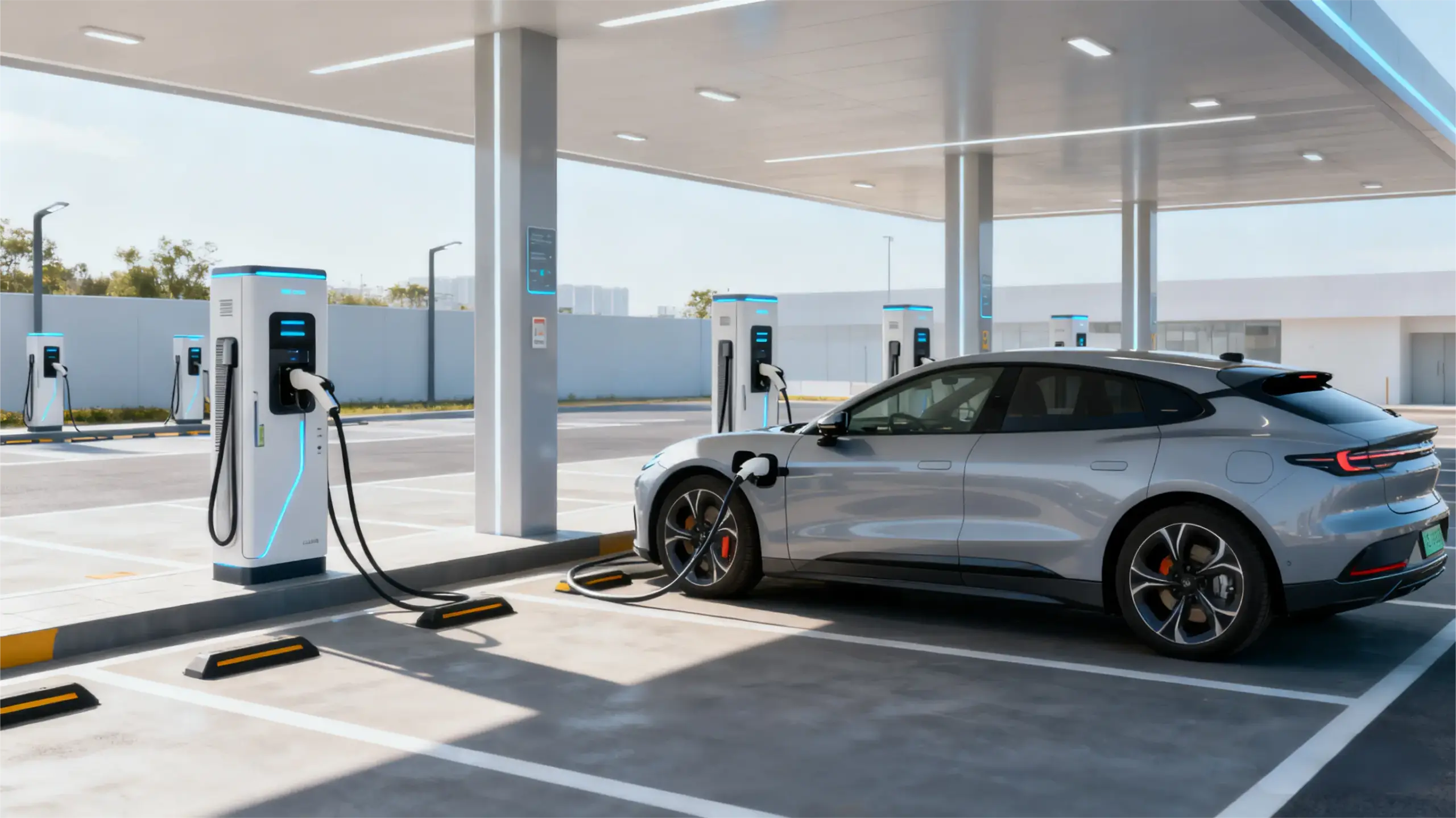
By contrast, electric vehicles (EVs) often operate at 1C to 3C or higher, depending on acceleration demand and fast-charging requirements. While EV batteries are optimized for high power density, stationary storage systems like FFDPOWER’s Galaxy Series are engineered for long-term stability and safety, typically operating within the 0.5C to 1C range.
In summary, the “right” C-rate is not about pushing the limit — it’s about finding the perfect match for the application. Whether it’s a home, factory, or power grid, the optimal C-rate ensures the system delivers the best combination of speed, safety, and lifespan.
4. FFD POWER’s Approach: Intelligent Control of C-Rate
FFD POWER believes that the future of energy storage lies in intelligent optimization.
Through its advanced Energy Management System (EMS) and AI-powered BMS, FFD POWER continuously monitors real-time current, voltage, and temperature data. The system dynamically adjusts the charge and discharge rates according to:
Grid demand and energy pricing
Battery health (State of Health and State of Charge)
Thermal conditions
Operational and economic optimization strategies
This real-time control allows each system to operate at the ideal C-rate — fast when needed, gentle when appropriate — achieving:
✅ Enhanced safety and thermal stability
✅ Longer battery lifespan
✅ Higher round-trip efficiency
✅ Lower total cost of ownership (TCO)
By combining AI algorithms, data analytics, and precision control, FFD POWER ensures every battery works at its optimal acceleration — maximizing performance while protecting long-term value.
5. Balancing Power and Longevity
Choosing the right C-rate is always a trade-off between power and endurance:
A high C-rate delivers quick power but shortens battery life.
A low C-rate extends longevity but limits output speed.
FFDPOWER’s engineering philosophy is to balance acceleration with endurance — just like tuning a high-performance engine for long-distance reliability.
By combining top-tier Lithium Iron Phosphate (LFP) cells with intelligent system control, FFD POWER ensures that every energy storage system achieves both speed and sustainability.
Conclusion
The C-rate is more than a technical number — it’s the heartbeat of your energy storage system. It defines how fast your battery can react, how efficiently it performs, and how long it will last.
With intelligent control, robust design, and AI-driven optimization, FFD POWER ensures each system operates at the perfect C-rate — achieving the best balance between power, safety, and longevity.
Because in energy storage, true performance is not just about how fast you can go — it’s about how long you can keep going strong.