News
Grid-Forming BESS: Why VSG Mode Is the Answer for Scalable Off-Grid Architecture
- January 1, 2026
For over a century, the heartbeat of our power grid—its frequency and stability—has been governed by the spinning mass of synchronous generators in large coal, gas, and hydro plants. But as the world shifts toward clean and renewable energy, an increasing share of generation is delivered through power-electronic converters—PV and wind plants, variable-speed machines, and other inverter-interfaced resources. Most of these assets are designed to be grid-following: they rely on a pre-existing voltage and frequency reference, synchronizing to the grid rather than creating it.
They perform brilliantly when a strong voltage/frequency reference exists. But when the grid is weak, unstable, or absent, the question becomes brutally simple:
Who creates the grid that everyone else needs to follow?
That question is the origin story of Grid-Forming Battery Energy Storage Systems (Grid-Forming BESS)—and why grid-forming control has become a defining technology for scalable off-grid architecture
What Is Grid-Forming BESS?
Unlike traditional grid-following inverters, Grid-Forming BESS allows battery storage systems to create and regulate a stable voltage and frequency waveform. It gives batteries the ability to start an islanded bus (black start) and form a robust electrical foundation for other resources to follow—similar to a traditional power plant, but faster and more precise.
In practical terms, grid-forming BESS enables:
- Islanded operation where the BESS establishes the bus
- Black start capability (energizing an islanded bus from zero)
- Stable operation on weak grids, where grid-following behavior becomes unreliable
- A foundation for renewables, so PV and other inverter resources can synchronize and operate coherently
This is not a cosmetic feature. It is the difference between:
- “We have storage,” and
- “We can run a stable islanded power system.”
Why Grid-Forming Technology Became Necessary
Grid-forming BESS is the control-layer response to a structural shift: as decarbonization accelerates, synchronous generators decline and inverter-based resources (PV, wind, converter-interfaced assets) supply more of the grid. What’s lost is not only megawatts, but the physical behaviors that kept voltage and frequency stable. Grid-forming BESS rebuilds those behaviors with fast, programmable inverter control.
The key gaps it closes are:
- Inertia and damping no longer come “for free.”
With less rotating mass, frequency moves faster and oscillations can be harder to damp. Grid-forming BESS provides synthetic inertia-like response and active damping to shape system dynamics in real time.
- Grid-following resources cannot lead without a reference.
Most inverter resources need an existing voltage/frequency reference. In weak grids, black starts, or islanded microgrids, that reference may be unstable or absent—so resources trip or derate. Grid-forming BESS acts as the foundational voltage source that others can follow.
- Off-grid systems must scale modularly.
Loads grow and capacity is added in phases. Without a grid-forming backbone, multi-unit expansion becomes a control-integration risk. Grid-forming BESS enables stable parallel operation and cleaner load sharing across units.
In essence, Grid-Forming BESS transforms batteries from passive storage assets into active grid-forming pillars. They establish the electrical heartbeat of the grid, provide essential stability services, and enable a modular, resilient path to a 100% renewable future.
PQ, VF, and VSG: Three Modes, Three Very Different Outcomes
Grid-forming is not “one mode.” In real BESS projects, you will encounter three common control approaches at the PCS layer: PQ, VF, and VSG.
1) PQ Mode: Dispatch-Oriented, Typically Grid-Following
PQ control commands active power (P) and reactive power (Q). It is excellent for scheduled dispatch and grid-connected services. But PQ mode usually assumes the grid already exists as a stable reference. In off-grid conditions, PQ is typically used after a grid-forming source has established a coherent bus.
2) VF Mode: Direct V/f Regulation, Classic Grid-Forming
VF control regulates Voltage and Frequency directly. It can establish an islanded bus and is widely used in microgrid operation.
VF is often effective for:
- single-unit island systems
- small-parallel systems with well-defined electrical conditions
As systems scale, VF-based parallel operation can become sensitive to feeder impedance differences, circulating currents between parallel voltage sources, and tuning complexity under real transients and mixed loads.
3) VSG Mode: Grid-Forming With Machine-Like Dynamics
VSG (Virtual Synchronous Generator) control is grid-forming, but it shapes the inverter’s dynamic behavior to resemble key characteristics of synchronous machines—especially how frequency and phase respond under disturbances.
Instead of only “holding V and f,” VSG typically introduces:
- inertia-like response to smooth frequency movement during sudden load steps
- damping-like behavior to reduce oscillations and improve settling
- structured power-angle dynamics that support coherent multi-source operation
In off-grid architecture, VSG is often chosen because it makes multi-inverter grid-forming more predictable at scale.
Why VSG Control Fits Scalable Off-Grid Architecture
In a scalable off-grid system, the hardest part is not energy capacity—it is getting many inverters to behave like one coherent power plant. The moment you parallel multiple grid-forming units, two questions decide whether the architecture scales cleanly:
- How do they share active power?
- How do they share reactive power while keeping the bus voltage stable—without circulating currents?
A VSG-controlled inverter behaves as a voltage source with synchronous-generator-like dynamics, while droop provides the decentralized sharing law that prevents parallel voltage sources from “fighting.”
P–f droop (active power sharing): when a unit carries more P, it slightly reduces its frequency reference. Because all units see the same bus frequency, they naturally converge to a common operating point and share active power according to droop slope and capacity settings—without high-bandwidth communications.
Q–V droop (reactive power sharing): when a unit supplies more Q, it slightly reduces its voltage reference, encouraging other units to pick up reactive power and reducing the risk of circulating reactive currents.
Droop can be applied to other grid-forming modes, but VSG adds what matters in real off-grid transients: virtual inertia and damping that shape how frequency and voltage move and settle after step loads or switching events. The result is a grid-forming cluster that behaves more like a multi-generator plant—small deviations under disturbance, followed by smooth stabilization—making multi-unit paralleling far more robust as unit count increases.
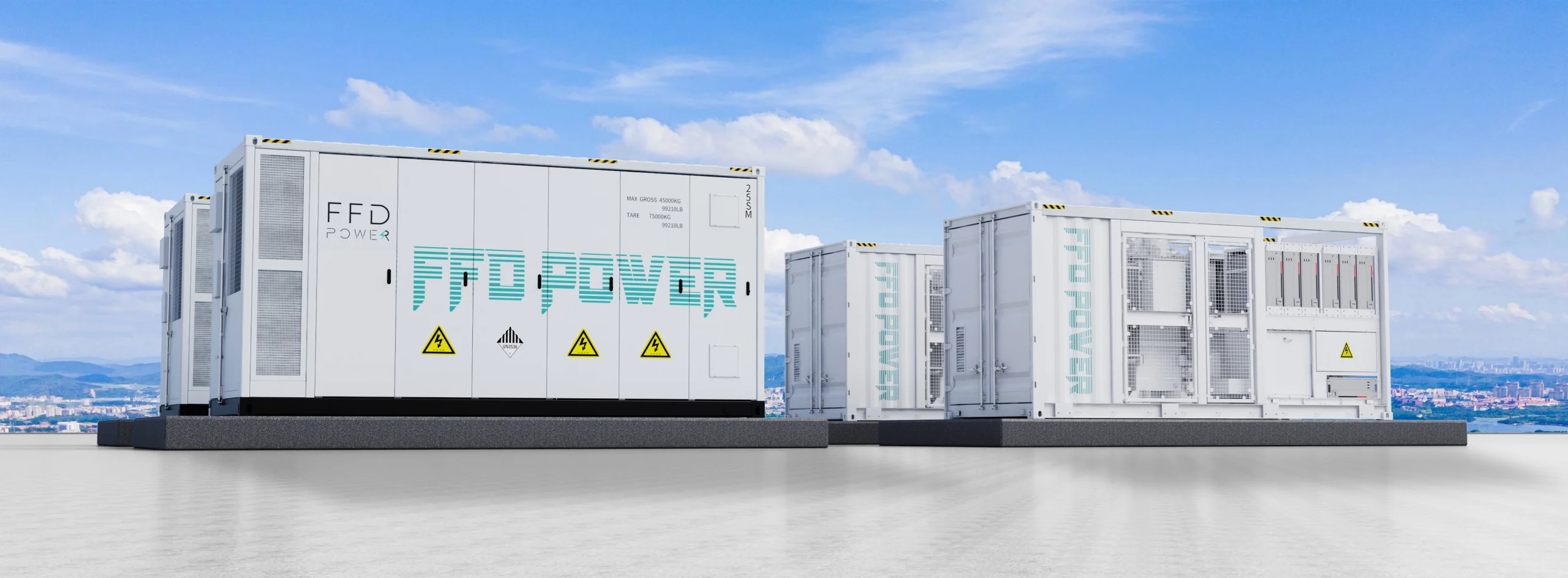
FFD POWER: VSG-Mode Battery Cabinets Supporting Up to 20 Units in Off-Grid Parallel Operation
FFD POWER delivers a battery cabinet solution designed for grid-forming operation under VSG control, engineered for scalable off-grid architecture. In VSG mode, the system supports up to 20 units in off-grid parallel operation, delivering scalable power and redundancy through a modular, multi-inverter grid-forming architecture. For a typical 125 kW / 261 kWh all-in-one system, this enables expansion up to 2.5 MW.
This capability is particularly aligned with off-grid projects that require:
- staged capacity growth without architectural redesign
- stable island operation for critical or industrial loads
- PV + BESS microgrids where the BESS establishes a clean electrical foundation
- multi-unit redundancy without relying on one “main” grid-forming box
When off-grid is not a temporary condition but the operating reality, the architecture must be built around a stable reference. Grid-forming BESS provides that foundation—and VSG control is the answer when the foundation must scale.
FAQ
Q. In a PV + BESS microgrid, what changes when the BESS is grid-forming?
A: In many legacy PV systems, the PV inverter is grid-following, so when the utility grid is lost it cannot generate in island mode—it has no voltage/frequency reference and typically shuts down. With a grid-forming BESS, the battery inverter establishes the bus voltage and frequency, so PV inverters can synchronize as followers and keep producing power. This avoids the “all-followers” failure during islanding and improves stability under PV ramps and step loads, making high-renewable microgrids practical.
Q: Why can’t we just use VF mode for large-scale parallel operation?
A: VF can work in theory, but it scales poorly because multiple “voltage sources” in parallel are sensitive to mismatch and line impedance. In practice, VF is often implemented as master–slave: one unit sets the bus V/f and others run as followers (often PQ), because running many VF “voltage sources” in peer-to-peer parallel is tuning-sensitive. As you scale, master–slave introduces a single-point dependency (the master) and complicates expansion/maintenance; peer VF increases the risk of circulating currents and uneven Q sharing due to impedance mismatches. This is why scalable off-grid designs often prefer VSG with P–f / Q–V droop, enabling peer parallel operation without a fixed master.
Q. How does VSG enable multiple inverters to share load without a “master controller”?
A: In practical multi-unit operation, VSG is typically paired with droop control:
- P–f droop shares active power: a unit that picks up more P slightly reduces its frequency reference, and the fleet converges to a common bus frequency while splitting P according to droop slopes/capacity settings.
- Q–V droop shares reactive power: a unit that supplies more Q slightly reduces its voltage reference, encouraging balanced Q sharing and reducing circulating reactive currents.
This droop-based method enables decentralized, scalable paralleling without high-bandwidth coordination.