FFD POWER Proprietary
Redefining Reliability: The FFD Two-Tier Intelligent BMS
FFD POWER’s proprietary BMS is engineered to transcend the limitations of conventional energy storage management. By moving away from rigid, inefficient 3-layer architectures, we have pioneered a Two-Tier Decentralized Master Architecture that delivers true industrial-grade resilience and intelligence.
What problems Apex Master-Less BMS resolve ?
In conventional energy storage systems, a centralized "Master" controller acts as the single brain. If this component fails—due to a communication glitch or hardware malfunction—the entire system loses its coordination and undergoes a total shutdown, leading to costly downtime. FFD POWER’s Master-less BMS redefines reliability through a decentralized, peer-to-peer network. By implementing an Active Competitive Master Mechanism, every BMS in the system possesses the intelligence to lead. If the primary unit encounters an issue, a successor is elected within milliseconds. This seamless transition is invisible to the grid, ensuring that your energy supply remains constant and your system remains operational 24/7, regardless of individual component status.
The "Shortest Board Effect" (Barrel Law) has long plagued the industry: in traditional 3-layer architectures, if a single battery cluster reaches full charge or discharge limits, the master controller forces the entire system to stop to prevent overcharging. This results in significant wasted capacity in the remaining clusters. Our Two-Tier Intelligent Architecture allows for Asynchronous Cluster Management. Each battery cluster operates at its own optimal pace. When one cluster is fully charged, our BMS intelligently notifies the PCS to adjust the total power and isolates only that specific cluster, while allowing the others to continue their cycle. This ensures that every cluster in the site reaches its 100% or 0 State of Charge (SoC) , maximizing your total energy throughput and increasing the overall ROI of the asset.
Traditional systems often require complex manual re-addressing and site-wide logic reconfiguration whenever a BMS module is replaced or a new cluster is added. This requires specialized technicians and hours of system recalibration. FFD POWER’s decentralized logic turns maintenance into a Plug-and-Play task. Since there is no fixed master, a new or serviced BMS unit can be integrated into the existing rack without manual software mapping or complex communication debugging. The system automatically recognizes the new node and incorporates it into the competitive logic. This drastically reduces the Mean Time to Repair (MTTR) and lowers long-term operational costs, allowing your local team to manage the system with minimal technical overhead.
Apex Master-Less BMS Core Architecture: Two-Tier Intelligent Management
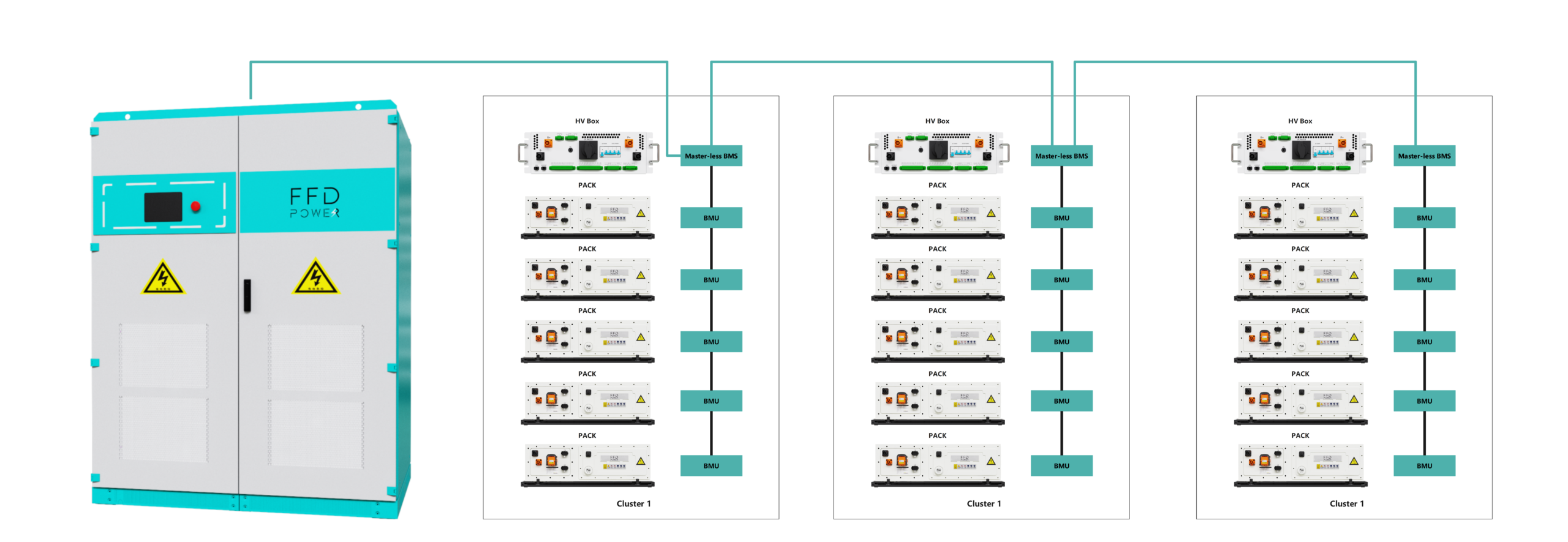
The Sensory Nerve Integrated directly within each Battery Pack, the BMU acts as the front-line data guardian. It performs high-precision, real-time acquisition of critical cell-level data, including voltage, temperature, and current. By monitoring these parameters at the source, the BMU ensures that the "health" of every single cell is continuously tracked and reported
The Intelligence Hub Integrated within the HV BOX (High-Voltage Control Box), the BMS serves as the system’s decision-making center. It aggregates data from all BMUs and executes sophisticated logic algorithms to manage battery safety, balancing, and state estimation (SoC/SoH). Its primary role is to bridge the gap between the battery clusters and the external world, ensuring seamless, high-speed communication with the EMS and PCS.
The Role of the HV BOX (High-Voltage Control Box)
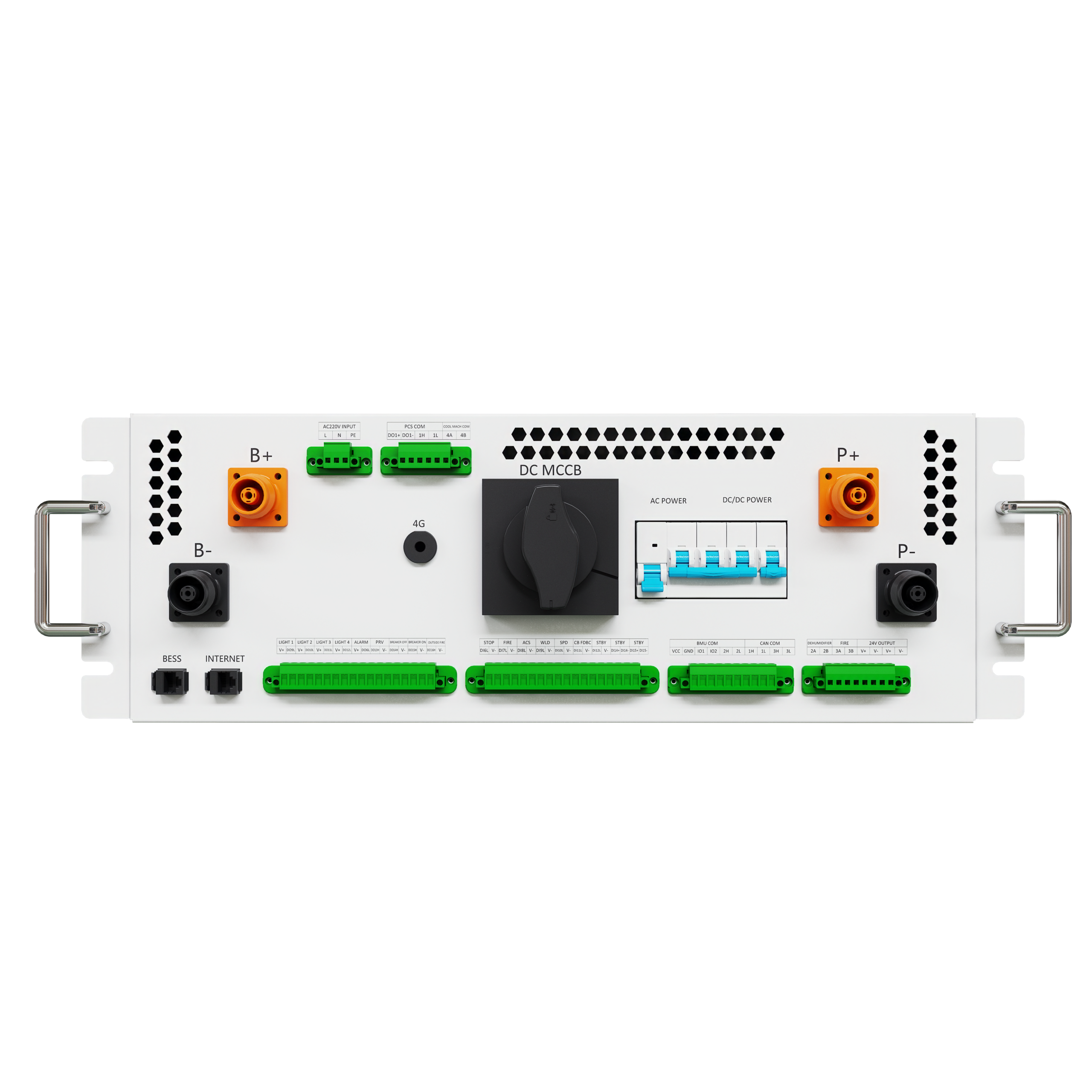
The HV BOX is the strategic command center for each battery cluster. It is not merely an enclosure, but a high-performance integration of logic, protection, and power distribution:
The integrated BMS processes all incoming data within the HV BOX. When the logic determines an operational boundary is reached, the HV BOX executes the command—such as connecting or disconnecting the cluster—with millisecond precision.
The HV BOX houses critical safety hardware, including high-voltage contactors, fuses, and circuit breakers. It acts as the "physical gatekeeper," providing reliable electrical isolation to protect the system and personnel during faults or maintenance.
By centralizing the BMS and high-voltage components, the HV BOX provides a clean, unified output for the entire cluster. It manages the high-voltage power flow to the PCS while simultaneously handling the low-voltage communication signals, greatly simplifying site-level wiring and integration.
Within our "Master-less" framework, the HV BOX of any cluster can dynamically step up to coordinate the entire DC bus, ensuring that the system’s decision-making power is always physically protected and operationally ready.