News
The Rise of Microgrids: How Businesses Achieve Energy Independence through Energy Storage
- October 31, 2025
The global energy landscape is changing fast. Rising electricity costs, grid instability, and the urgency of decarbonization are pushing businesses to rethink how they source and manage power.
In this transition, microgrids — localized, self-sufficient energy systems — are emerging as a powerful solution. When combined with advanced energy storage systems (ESS), microgrids enable businesses to achieve true energy independence, reduce costs, and ensure resilience against outages.
This article explores how microgrids work, why energy storage is the key enabler, and how companies like FFD POWER are driving this transformation worldwide.
What Is a Microgrid?
A microgrid is a small-scale, localized power network that can operate with or without connection to the main utility grid.
It typically integrates multiple energy sources, such as:
Solar PV or wind turbines for renewable generation
Diesel or gas generators for backup power
Battery energy storage systems (BESS) for stability and optimization
What makes a microgrid unique is its intelligent control system, which manages generation, storage, and load to maintain a stable and efficient energy flow.
When the main grid fails, the microgrid can island — automatically disconnect and continue supplying power independently. This makes it invaluable for industrial sites, hospitals, data centers, and remote facilities.
Why Businesses Are Turning to Microgrids
Across industries, the shift toward microgrids is accelerating due to several major drivers:
1. Rising Electricity Prices
Energy-intensive businesses face volatile and rising utility tariffs. By generating and storing their own power, companies can reduce dependence on the grid and take advantage of time-of-use pricing — charging batteries during off-peak hours and discharging during peaks for cost savings.
2. Energy Reliability
Power outages can disrupt operations, damage equipment, and cause financial losses. A microgrid with energy storage ensures uninterrupted power supply, protecting business continuity.
3. Sustainability Goals
Corporate carbon reduction targets are now a global standard. Microgrids enable higher use of renewable energy by storing excess solar or wind energy and releasing it when needed, helping businesses achieve net-zero emissions.
4. Grid Independence
For facilities in regions with unstable or limited grid infrastructure — especially in Africa, Southeast Asia, and Latin America — microgrids provide a practical path to energy autonomy.
The Role of Energy Storage in Microgrids
Energy storage is the core technology that transforms a traditional distributed energy setup into a true microgrid. Without it, renewable-based systems would struggle to maintain stability and reliability due to the fluctuating nature of solar and wind generation.
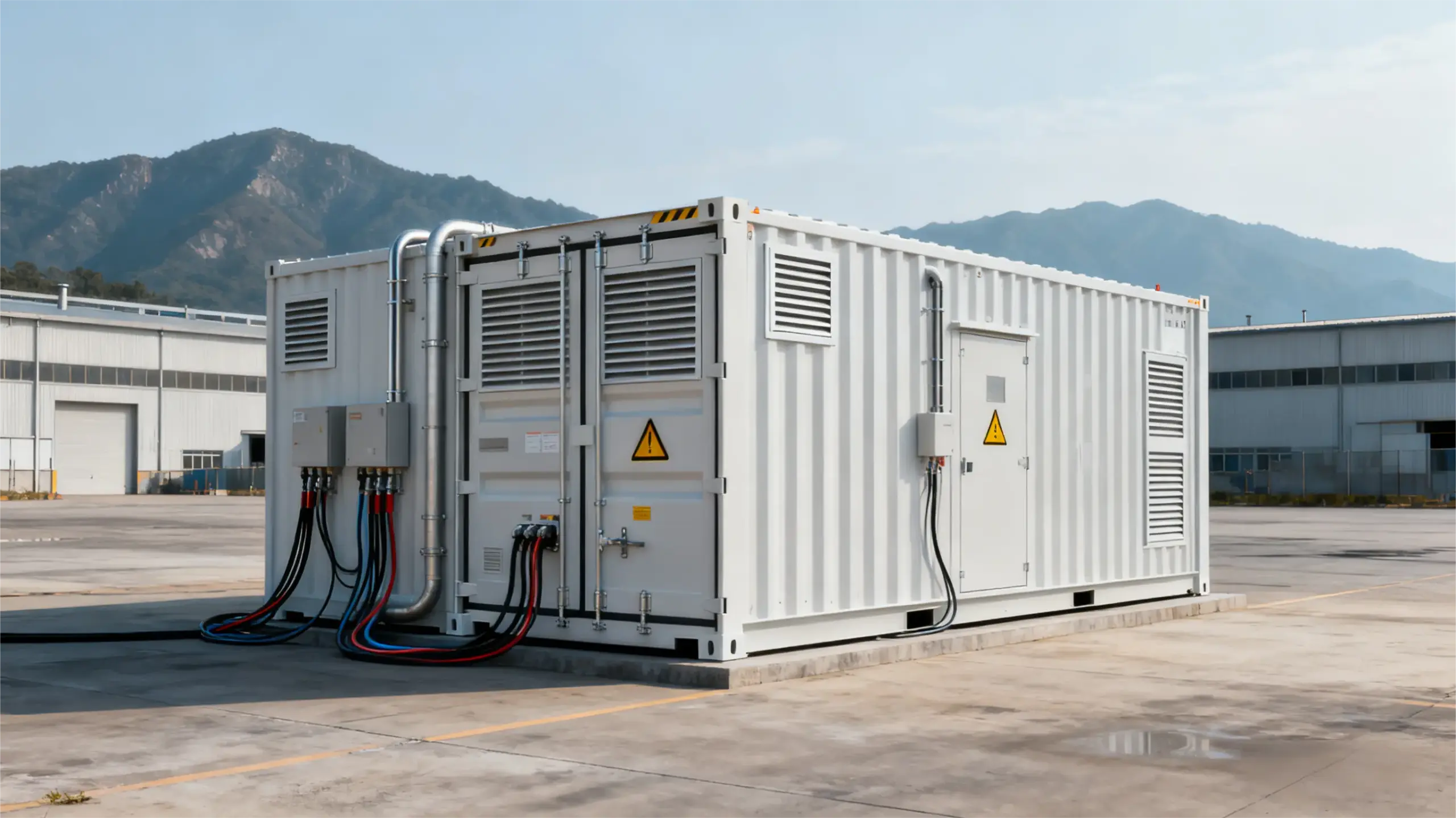
In a microgrid, the battery energy storage system (BESS) acts as both a stabilizer and an optimizer. It stores surplus energy when production exceeds demand and releases it when renewable generation drops. This process, known as energy balancing, ensures that the power supply remains continuous and predictable.
Another major advantage is peak shaving — the ability to discharge stored energy during high-demand or high-tariff periods. This helps businesses lower their electricity bills and avoid expensive demand charges from the utility grid.
Energy storage also provides backup power, instantly responding to grid failures or generator downtime. This capability is critical for industries such as manufacturing, healthcare, and telecommunications, where even a few seconds of power loss can lead to significant operational or financial damage.
Beyond reliability, batteries improve power quality by stabilizing voltage and frequency, protecting sensitive equipment and reducing the risk of electrical faults. Moreover, they enable renewable energy optimization — allowing solar and wind energy to be used more efficiently and reducing curtailment when production exceeds consumption.
Modern Lithium Iron Phosphate (LFP) batteries, like those used in FFDPOWER’s systems, are especially well-suited for microgrids. They offer long cycle life, exceptional thermal stability, and high round-trip efficiency, ensuring safe and sustainable energy management for years of continuous operation.
In short, energy storage is what gives microgrids their intelligence, flexibility, and resilience — turning them from passive energy networks into active, self-sustaining power ecosystems.
Real-World Applications
a. Industrial Energy Arbitrage
Factories can reduce electricity bills by charging storage units at night and discharging during the day.
→ Example: A Spanish beverage factory used FFDPOWER’s Galaxy 233L-AIO-2H units to perform peak shaving, cutting energy costs by over 25%.
b. Off-Grid Commercial Operations
In remote areas, microgrids with solar + storage operate independently from the public grid.
→ Example: A Mediterranean supermarket equipped with 8 Galaxy 233L-AIO-2H systems and a 1 MW rooftop solar array now runs fully off-grid, ensuring energy reliability and lower costs.
c. Critical Infrastructure
Hospitals, telecom stations, and data centers use microgrids to ensure 24/7 power reliability — with storage acting as a silent, instant backup.
The Smart Layer: Energy Management Systems (EMS)
A microgrid’s intelligence comes from its Energy Management System (EMS).
FFD POWER’s AI-powered EMS analyzes real-time data — such as load profiles, solar generation, and electricity tariffs — to optimize charging, discharging, and power dispatch automatically.
Key features include:
Predictive optimization using weather and price forecasting
Dynamic control of power flow between grid, storage, and loads
Remote monitoring and diagnostics for proactive maintenance
With AI integration, microgrids evolve from static systems into self-learning, adaptive energy ecosystems.
The Future: Decentralized and Intelligent Energy Networks
The rise of microgrids represents a shift from centralized power generation to distributed, intelligent energy networks.
As battery technology advances and costs fall, more businesses are embracing microgrids not just as backup solutions — but as strategic energy assets.
Microgrids will play a central role in:
Corporate decarbonization strategies
Smart industrial parks and eco-zones
Rural electrification and community resilience
By combining renewables, storage, and AI, microgrids enable the next generation of clean, resilient, and independent energy systems.
FFD POWER’s Commitment
At FFD POWER, we believe that energy independence is the foundation of sustainable growth.
Our modular microgrid solutions integrate top-tier LFP batteries, intelligent EMS, and high-efficiency PCS — providing businesses with flexible, scalable, and secure power systems.
Whether on-grid, off-grid, or hybrid, FFDPOWER delivers turnkey microgrid solutions that empower industries to take control of their energy future.
Conclusion
Microgrids are redefining how businesses generate, store, and use power.
By combining renewable energy with advanced storage and smart management, companies can achieve cost savings, energy security, and environmental sustainability — all at once.
The microgrid revolution is not coming — it’s already here. And FFD POWER stands ready to help businesses lead the charge toward a cleaner, more independent energy era.