News
Application of Energy Storage in Hydrogen, Wind, and Other Renewable Energy Fields
- October 13, 2025
As the global energy landscape transitions toward decarbonization, renewable sources such as hydrogen, wind, and solar are playing increasingly important roles. However, these energy sources share a common challenge — intermittency. Energy production fluctuates with weather and time, creating instability and inefficiency.
This is where energy storage systems (ESS) come in. Acting as the “bridge” between energy generation and consumption, ESS ensures reliability, flexibility, and optimal utilization of renewable energy.
The Role of Energy Storage in Renewable Integration
Energy storage provides the essential balancing and buffering capability that renewables lack. When excess renewable energy is produced, it can be stored for later use — during peak demand or low generation periods.
Key Functions:
Energy shifting: Store surplus wind or solar power during off-peak hours and release it during high-demand periods.
Grid stability: Maintain frequency and voltage stability by rapidly responding to fluctuations in renewable generation.
Peak shaving: Reduce grid stress and operational costs by managing load variations.
Backup power: Provide reliable electricity during outages or low renewable output.
Application in Wind Power Systems
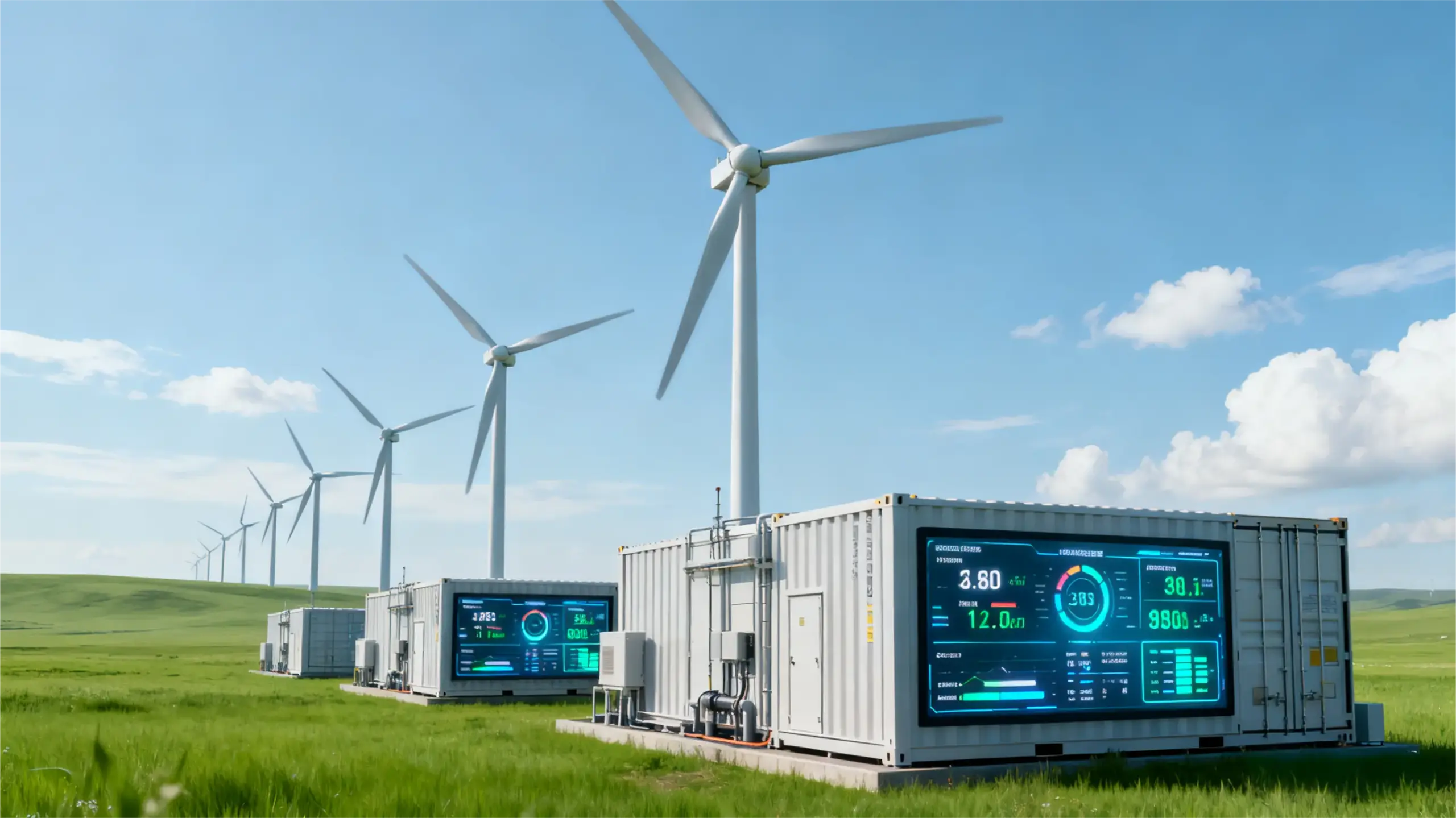
Wind energy is clean and abundant, but highly variable due to wind speed fluctuations. Integrating ESS with wind farms creates a more predictable and controllable power output.
Key Benefits:
Smoothing power fluctuations: Batteries can instantly absorb excess power or supply energy during lulls, stabilizing grid injection.
Improving grid compliance: ESS ensures wind power plants meet grid frequency and ramp-rate requirements.
Enhancing project economics: By storing energy during high-wind, low-demand periods, operators can sell electricity when prices are higher, improving ROI.
Example:
An offshore wind farm combined with a lithium-ion battery system can store excess nighttime energy and release it during morning peak demand, optimizing grid dispatch and profitability.
Application in Hydrogen Energy Systems
Hydrogen is emerging as a key pillar of future clean energy systems, often referred to as the “energy carrier of the future.” Yet, producing hydrogen efficiently depends heavily on renewable energy and energy storage.
ESS Enables Three Key Stages:
Green Hydrogen Production:
Renewable power (from solar or wind) is stored in batteries and released steadily to supply electrolyzers, ensuring consistent hydrogen generation.Energy Conversion & Storage:
Hydrogen can itself act as an energy storage medium, storing electricity chemically for long durations — complementing batteries for seasonal or large-scale applications.Hybrid Systems:
Combining battery ESS + hydrogen storage creates a dual-layer storage system — short-term stability via batteries and long-term energy balance via hydrogen.
Benefits:
Stabilizes intermittent renewable power for hydrogen production.
Increases electrolyzer utilization rate and economic efficiency.
Enables 24/7 renewable hydrogen generation with minimal fossil backup.
Application in Solar and Hybrid Renewable Systems
While solar energy is predictable on a daily cycle, it disappears at night and fluctuates with weather. Coupling energy storage with solar and other renewables allows for hybrid, self-sustaining microgrids.
ESS Enhancements:
Store excess daytime solar energy for nighttime use.
Enable off-grid and microgrid operations in remote areas.
Support hybrid renewable systems combining solar, wind, and hydrogen for stable and continuous power supply.
Example:
A hybrid renewable microgrid integrating solar panels, wind turbines, and a battery ESS can power remote industrial sites or islands without relying on the main grid — achieving true energy independence.
The Future: AI-Driven Energy Management
With multiple renewable sources and complex storage systems working together, intelligent control is critical.
Modern Energy Management Systems (EMS), enhanced by AI and IoT technologies, dynamically optimize charging, discharging, and energy dispatch to maximize efficiency and safety.
FFDPOWER, for example, integrates AI-based predictive algorithms to forecast renewable generation, optimize battery usage, and maintain system balance in hybrid energy environments — ensuring both economic and operational excellence.
Conclusion
Energy storage is the core enabler of the renewable revolution.
Whether in wind, solar, or hydrogen systems, ESS enhances stability, reliability, and economic performance — transforming intermittent renewables into dependable power sources.
As global demand for clean, flexible, and intelligent energy solutions grows, integrating advanced storage technologies with renewable systems will be the key to achieving a sustainable, carbon-neutral energy future.